

The more we lean into our work for the mental wellness of youth, the more we’re convinced that community is key to our anti-bullying and peace-building mission. We’ve seen it in our collaboration with educators, counselors, and school administrators. We’ve witnessed it in the impact of parents, caregivers, and youth leaders. And we’ve been inspired by the overwhelming generosity of donors and supporters.
“As we took our anti-bullying message into schools and spoke with educators over the last few semesters, we identified a real need for a version of the curriculum designed especially for high school students,” says Tammy Jensen, Heroes In Waiting education coordinator. “With more complex social structures and 24/7 access to social media, we realized older kids face unique mental wellness challenges, and we need to be able to meet them where they are.”
So Tammy got to work. She was well into curriculum development for older students when Heroes In Waiting got a call from Whitney Finley, a teacher of English and interdisciplinary studies and sponsor of the American Design Project junior-level class at Casady School’s upper division in Oklahoma City, Oklahoma. Finley and Casady administrator BrieAnn Lund Johnson explained that the goals of the American Design Project are for students to learn about needs that exist in their community and to research local organizations that are working to address these needs using “design thinking.” The students had recently experienced a Heroes In Waiting anti-bullying and peace-building assembly, and the impression it left led them to choose Heroes In Waiting for their project.
“It was really interesting how you guys put an emphasis on the mental health and well-being of bullies as well as victims, suggesting that bullies usually act the way they do not because they want to, but because there’s something going on in their own lives that may motivate them,” said one of the team members.
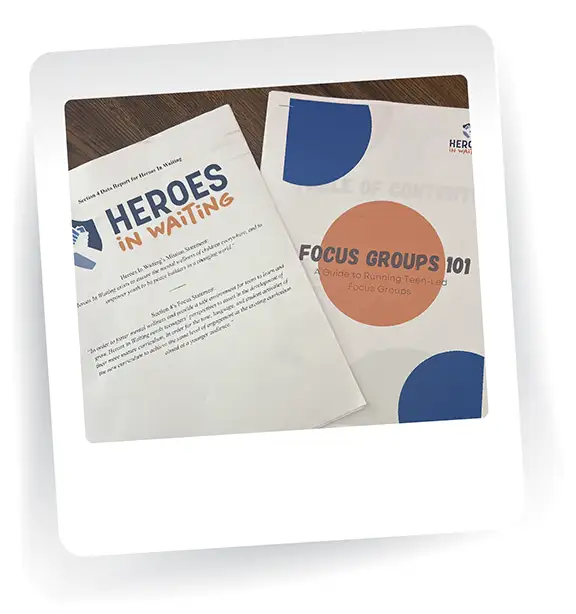
“After many meetings of them finding out more about our mission and what we were working on within the organization, we brainstormed about the high school curriculum and how their group could help with this project,” says Tammy. “They came up with the idea of the focus groups and ran with it.”
The result was a stellar student-run research project that included five focus groups representing 63 8th-12th graders in three Oklahoma City schools. In addition to in-person focus groups, the research garnered individual surveys from 19 public, private, charter, and home school students across Oklahoma. The team asked these high school students to experience our middle-school curriculum, then posed questions about what specific changes were needed to create a curriculum that was appealing to and relevant for older students.
The exhaustive data the team gathered – including quantitative and qualitative measurements, direct quotes from students as well as observations about body language and non-verbal reactions – has been key to our work of re-imagining the curriculum for high school students.
“The dedication and insight of the student team have been instrumental in transforming the way we approach our curriculum for an older age group,” says Tammy. “Their ability to analyze and interpret the data from focus groups and surveys has not only enhanced our understanding of the needs of the new curriculum development, but has also inspired innovative wording and phrasing that will shape the future of our new curriculum.”
Thanks to Casady’s American Design Project team, our high school curriculum is now in full production, and we look forward to rolling it out FREE to high schools across the country with the help of a generous grant from Love’s Travel Stops.